Energy Maths
· Originally published on Substack
“If you have always done it that way, it is probably wrong.”
Charles Kettering
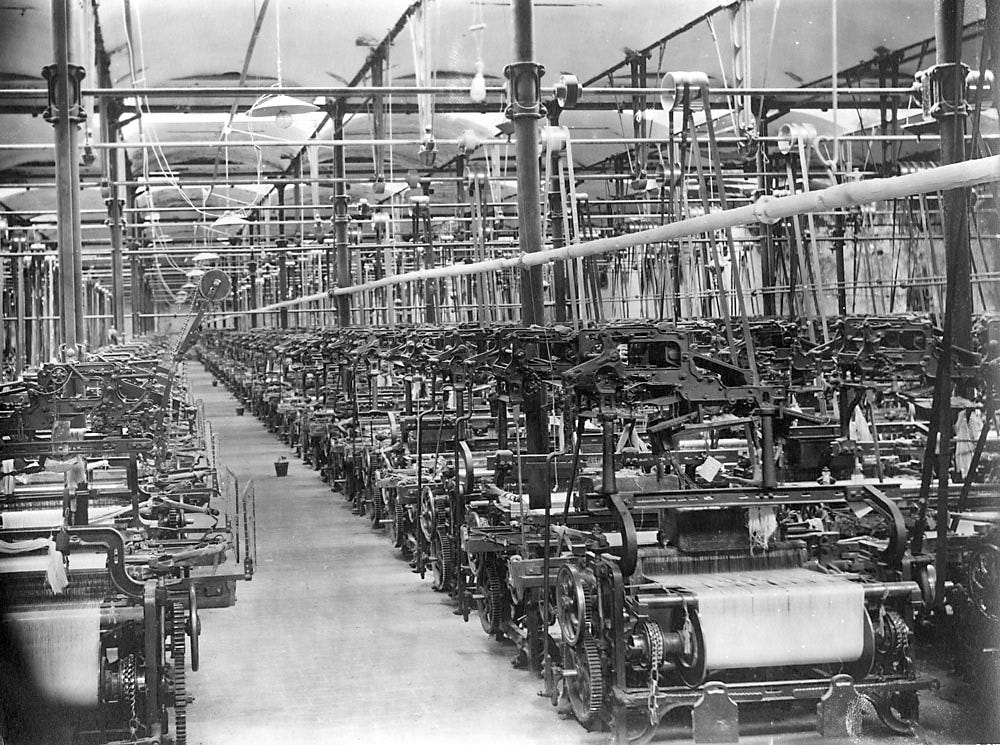
By / MNACTEC, Fondo Manufacturas Sedó, S.A., Public Domain, link
One of the things I discovered at SRTX was a way of thinking which I believe makes it cheaper to manufacture things - it acknowledges that all things cost energy - but it presumes that things might be able to exist with little else. I call it Energy Maths.
Energy Maths is a new way of thinking about your Cost of Goods Sold (COGS) and your Cost to Produce (CTP) based on the premise that things should be approximately free. It provides more opportunity to reduce these critical metrics, by providing greater clarity, and visibility, of the inefficiencies in your manufacturing process. If you manufacture a product, Energy Maths is how you do so for cheaper. The following is a primer.
First: CTP
There is a concept in accounting and manufacturing of COGS: Cost of Goods Sold. Assuming you are actually making the things you are selling, core to your COGS is CTP: Cost to Produce. COGS is just CTP plus what are usually minor extras: warehousing, packaging, shipping, 3PLs, and whatever labour is involved in those activities. I'm getting a little ahead of myself, but the extras that turn COGS into CTP can probably be simplified into freight - which is really just energy - more on this in a second.
The point that I'm making is: Focus on CTP, forget about COGS. I find it simplifies things. COGS is nearly impossible to improve without reducing CTP. So focus on CTP.
I spent the first half of my time at SRTX as COO, where my mission was reducing our CTP to $zero. SRTX makes pantyhose. Conventional pantyhose costs a few dollars a pair to make - pretty close to their theoretical energy maths’ minimum. By contrast, in the beginning at SRTX our tights cost well over $100 per pair to make. That's a big gap. Reducing CTP from over $100 to $2 is a huge mission. It sounds like nonsense. This isn’t finance - CTP is real, it’s physics. It’s atoms & energy: material, time, labour, machines, factory space, etc. How do you reduce any of those things by 99%, let alone all of them?!
For me, that's where energy maths was born. Before I could imagine reducing a metric by 99%, I first tried to imagine: if I were only constrained by atoms & energy, what would it cost? How much do the atoms cost? How much energy is required? Imagine we have infinitely many, perfectly operating, zero labour machines, in a free building with zero constraints - we only pay for the atoms that come in, and the energy we use. What's CTP in that idealistic vision?
Now let's minimise it more.
At a minimum we still buy power - the electricity to run our machines. Do we need a lot of energy? If things are going well, then probably we do… Could we locate our perfect factory somewhere close to energy? Where is energy cheaper?
And we buy atoms - the raw materials and commodities that we modify and assemble to make our products. Do we need a lot of atoms? Again, let's assume we are doing well, so yes… Where do they come from? Where do we send them when we are done? We should probably be in one of those places… Could we locate our perfect factory between the origin and destination in the most direct path the atoms will take?
For SRTX this meant locating our factory east of Ontario (Quebec) for the cheap hydro electricity, as close to Manhattan as possible for the customer, and near a petrochemical reactor for the input atoms (powder & oil). Montreal turned out to be an accidental, but pretty good spot. If Canadian oil were ever reacted in Canada, it would be perfect.
Now we add back all the imperfections. And we end up with a very different CTP formula than the one your finance team uses:
Traditional:
Energy Maths:
Second: Technical Debt
Technical debt is a concept used in software development to articulate the tradeoffs when making fast changes to a product. Moving faster can happen, by borrowing from the product, and from future development cycles when the debt will ideally get paid back.
Here I’m using the term technical debt to articulate everything about a manufacturing process that is unsolved. If you produce goods from an imperfect / unfinished factory - your CTP will reflect this - the maths must also.
Waste isn’t first class. Waste is debt. If you have greater than zero waste, it's simply because you haven’t yet done the technical work to delete waste from your manufacturing process. You, at some time, borrowed from the metrics of the factory to ship sooner, move faster, produce more, tweak the product, or whatever. Probably in part because you have too many people and not enough machines, and certainly not specific enough machines. You have debt that needs to someday be paid off.
Labour is no different. Labour isn’t core to CTP - it’s debt. Anything can be made by a machine - if you are still employing people to build your product, that is debt. Pay off the debt - innovate - develop the machine - reduce your CTP.
Consumables are also debt. Consumables are a result of a badly tuned machine, or a legacy process. It might not be worth paying off these debts - but it is still technical debt. The number of parts replaced on a machine per finished good produced will trend down over time if innovation and debt reduction is a priority.
Rent is a bit blurrier. Land, buildings and space have a cost. It's not quite atoms, or energy. But it is a debt in the sense that you still require a space to make your product. A more evolved version of your factory won’t. Someday you’ll need less space per finished good. Someday, maybe your factory will be fully distributed and seemingly ethereal. Frankly, it's an unlikely debt to be paid off, but it is still a debt.
Third: Atoms
Not all the technical debt is internal. Suppliers are probably passing along their technical debt to you (charging you more than their energy costs). But it's still just technical debt. Through automation, software, better design, better factories, more sensors, less waste, etc the things you buy from suppliers should cost roughly the energy they require to make. That's why you care what the atoms cost - as opposed to what you pay for them. The delta is your supplier's technical debt.
Digging into the delta is how you reveal opportunities for vertical integration. The bigger the delta, the more likely that you can invest in your own production capability to replace key suppliers, do the work of eliminating their technical debt, and provide yourself with cheaper atoms than you can buy from the market.
This rapidly becomes iterative. Say you buy paper packaging. You dig into the cost of the paper atoms, versus the cost of the packaging. You realise that you are paying a 90%+ delta. Paper atoms are very cheap. Your packaging costs a lot more. What if you bought your own folder-gluer? You could buy printed sheets of cardstock instead of assembled packaging - you’ve cut out a substantial amount of handling, labour, time and freight - you’ve reduced your costs by 50% for the exact same atoms. You’ve eliminated a huge amount of the technical debt by going a tiny bit vertical. You will probably never buy a pulp factory - but it becomes a slippery slope… Assuming capital is available - you can drive a tremendous amount of debt out of your product by verticalizing your acquisition of atoms.
Here's what our formula looks like now:
Ideal:
Realistic:
Technical Debt:
Fourth: Energy
Energy is outside our scope. This is purposeful. You are probably not developing fusion power (if you are, my deepest respect - you are saving humanity - let me know if I can help). Our only role with energy is to be thoughtful and efficient. It's not our place to make energy more available or cheaper or get bamboozled by utility maths and government offsets. Our place is to convert energy into finished goods as efficiently as possible. We should use efficient energy sources - burning fuels is likely inefficient - switch to electricity, assuming your electricity comes from something other than your energy company burning fuels. We should consume our energy efficiently - deploy capital to: replace old machines, upgrade to Heat Pumps, add VFDs, add Control Systems, add Monitoring, etc.
Tangent Alert: The only extracurricular thinking I allow for here is the realisation that if all things are made by energy maths, then all factories will relocate to parts of the world with available and cheap high quality, low impact energy. That seems worth lobbying. It means exiting China. But it also means exiting Germany, the US, Ontario, etc. There are a small number of places with abundant clean energy, fewer are investing in sufficient nuclear power. The country that wins the factories of the future is building lots of nuclear power plants today.
Fifth: Capital
Core to building factories, reducing CTP, and verticalizing is capital. It's fine to desire a lower CTP, and often there are even some simple inefficiencies that can be resolved with minimal capital investment. But mentally switching to seeing CTP as energy maths comes with a need for capital. Your product could be approximately free to make. Energy maths will help you uncover entire worlds of improvement that are possible. That said, you will need to muster the will, the innovation, and critically, the capital, to see it realised.
My experience using energy maths at SRTX…
SRTX was transformed. I fought through my discovery of energy maths and realised that we were producing a finished good that was over 99% technical debt. It was staggering. Our atoms cost a tiny, tiny fraction of what we were paying for them. Our energy consumption was and would be trivial. At scale both remained small. Every other raw material we purchased could be internalised and innovated slightly, with costs massively reduced.
I found my path to the CTP reduction that SRTX needed. Energy Maths was the transformative idea I needed. Imagining the world as atoms + energy + debt unlocked it. Seeing the debt as debt, revealed the problems to fix, which gave me the path to the 99% reduction in CTP the business needed.
And so my role changed, I was no longer COO, I took up innovation, and started the multi-year journey to systematically redesign and verticalize everything the business touched. We revisited the way we made tights, the machines, the labour, the automation, the physical building, and the materials we use. All of this was necessary. It allowed us to reduce our CTP massively - all the way to parity with traditional nylons.
I think it's worth saying that this would have been impossible if we remained trapped in conventional accounting thinking. It would have instead been a discussion on which of the financial account components could be reduced by a few percent. Can we negotiate a 5% discount on X? Can the labour output 2% more? Such a trap. Our minds would have remained closed to the truth: that everything is just atoms + energy + effort. Effort is fungible. Effort can be worked and eliminated. Atoms are real, but massively overpriced. Atoms are fungible by going to the source, and going vertical. Energy isn’t fungible. Energy can’t be eliminated. Energy must remain - and ideally, your CTP = energy. That is why I think of this as Energy Maths.
Next.
In my departure from SRTX I have returned to Energy Maths. I am baffled by how much of the world’s production is sold, and bought, with disregard to the simple calculation of Atoms + Energy + Debt.
Do people realise that the prices they pay for the houses they buy are not representative of the atoms, or energy, that went into building them? They are buying 99% debt. Energy Maths as applied to building houses - suggests that a house could be manufactured, in a factory, for two orders of magnitude less than they sell for today. We are simultaneously in a Canadian housing crisis and a knowledge crisis. This excites me. The potential impact from removing a zero or two from the CTP of a housing unit is incredible. The quality of life of the customer, the reckoning of the waste of the status quo, the solving of a literal crisis. Very, very exciting.
Food is no different. The atoms are actually approximately free. The energy comes almost entirely from the sun. Some energy is required to move it around - but only because we grow it in the wrong places. Food is approximately 100% technical debt. Someday it won’t be. I find that fascinating.
It's still early, and I don't want to over foreshadow, but I now believe that all stuff can, and should, cost approximately energy to make. Nearly of the world’s production costs more than the atoms and energy do - I'm very interested in fixing that - and I’m starting with the biggest problems I can tackle.
Thanks for reading. Subscribe for free to receive new posts and support my work.
Read, comment, or subscribe on Substack: https://zakhomuth.substack.com/p/energy-maths